

Improve your map
This page need to be update with the screenshots of the last GarganText version. The tips are however the same.
Your first map in 10 min (Part 2/2): Improve your map
version 3.0.5.7 Gargantext does not aim to have the last word on what a good map of knowledge is. It is designed to give the user, at every moment and at every level of granularity, the possibility to contribute to the delineation of the topic to be mapped. Thus, the knowledge maps proposed in Gargantext should be thought as a particular representation of a body of knowledge that is co-constructed between Gargantext and the user(s). A map is the coupling of :
- a corpora, defined by the user
- a list of terms defined by the Gargantext AND the user called the map list
- a set of measures made by Gargantext (relations between terms, quantitative measure on terms) based on these latter two elements.
The main source of improvement of an analysis and the corresponding maps is the modification of the list of terms that can take place at three levels.
Document level
When reading a document in the document view, you can add an remove on the fly terms from the ‘map list’ and the ‘stop list’. Select any expression in the text and follow the indications in the tool tip. The terms that are part of the map list are highlighted in green in the document view.
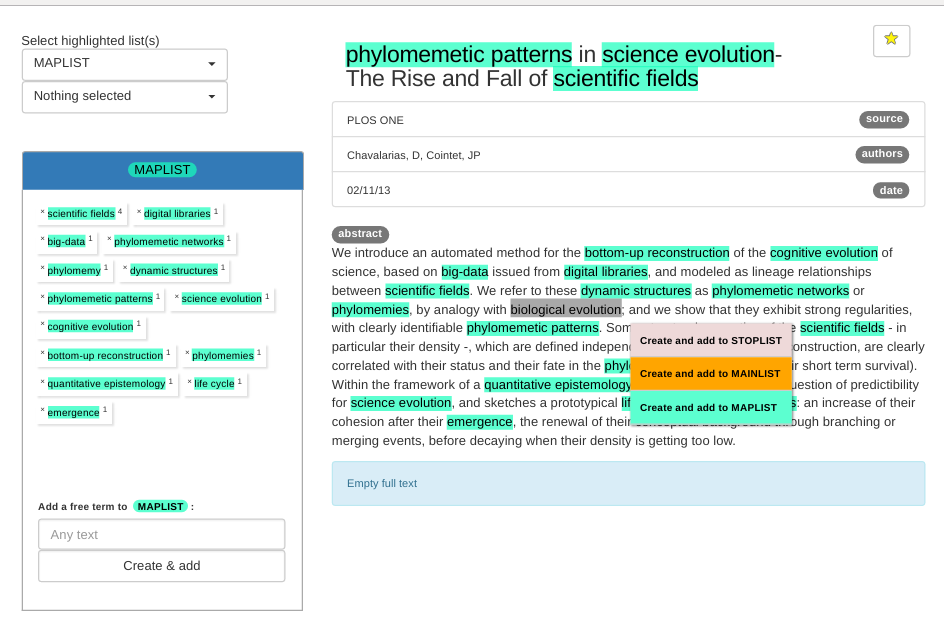
Snapshot of the document view. Add and remove terms from map list.

Use this drop-down list to view the full list, only map terms, only stop terms, or all the other terms that are neither in map list or in stop list.
Use this drop-down list to select only one word terms or multi-word terms. This is very useful because these two categories have very different behavior with respect to automatic identification of relevant terms.
Click on the Map/Del ‘all’ check box to batch remove of add terms from/to the map list.
Use the search field to sear all terms containing a given string.
Tips to speed-up map list edition in term table view
Here are few tricks that can considerably speed up the elaboration of a good map list. Two general remarks to begin with :
- One important thing to be aware of is that one-word terms and multi-words terms have very different behaviors regarding to the automatic selection of terms by Gargantext (it is easier to state the relevance of multi-word terms from a text-mining perspective). So selecting one or the other category of terms, you will apply different strategies for terms screening.
- When screening a list of terms, you will be more efficient if this latter is sorted in lexical order. All multi-terms with same start will be contiguous so that your eye will read only the last parts, leading to less cognitive load. With large list, it is always recommended to sort by lexical order (click on ‘Terms’ in the header of the terms table).
1) Screening Gargantext propositions (<2min) When Gargantext generates a map, it proposes you a first list of 350 terms (expressions with up to 5 words) that are the most significant according to a serie of metrics (like tf-idf). The quality of this list varies according to the complexity of your corpora with regard to text-mining. You can easily screen it in 2 min :
- First, select ‘map terms’ in the drop-down list (hot spot n°1 in image above) to display only the terms proposed by Gargantext for the map list.
- Select ‘one-word terms’ in the drop-down list (hot spot n°2 in image above) to first screen one word terms. You can sort them by lexical order to ease the reading. If this sub-list looks of good quality at first glance, then remove the less relevant terms one by one. If on the contrary, it looks of poor quality, then remove all terms from map list at once clicking in the ‘Del’ check box (hot spot n°3 in the above image) and then, before saving you changes, add one-by-one the few terms that are relevant for you.
- Select ‘multi-words terms’ in the drop-down list (hot spot n°2 in image above) to screen multi-word terms. Sort them by lexical order and screen them. They are generally of good quality so you will only have to remove less than 5% of them.
2) Adding expert knowledge (5 min or more) Because you often have some a priori knowledge on the important expressions of the field to be mapped, you can spend few minutes adding them to your map list. The most efficient is :
- Select ‘Candidate terms in the drop-down list (hot spot n°1 in image above). You will see all terms that are neither in the map list or in the stop list.
- Using the search box (hot spot n°4 in image above), search for parts of expressions that might be important for your topic (like ‘urb’, ‘knowledge’, etc.). Gargantext will display them and you will be able to add them one by one or in batch mode. You will notice that multi-word terms often will remind you new radicals that you will use in the next search.
- Last, you can end your screening spending 2 min looking at the most occurring terms in the ‘Candidate terms list’, viewing multi-terms, then one-word terms.
3) Group some terms Eventually, if you want to have categories in your maps or if you are aware of important terms that are equivalent in your analysis, you can group them using the terms grouping feature.
Term list level
For any analysis, the tab labeled as ‘Terms’ displays the list of terms and their statute. This is the main place to act on your list of terms to be mapped. With a single click , you can add or remove a terms from the map list or send it to the ‘stop list’ if you don’t want to include it in any future map.
- You can search for any radical or expression to check for the mention of some terms and add/remove several forms in batch mode (click on check box header Map/Del)
- You can filter by terms occurrences to screen a sub list
- You can sort by occurrences or lexical order for easier screening.
When you click on a term in the list, you change its statute : Not flagged –> Map list –> Stop list –> Not flagged The ‘save changes’ buttons appears each time a save operation is needed to save your changes.
Map level
In the map view, you can directly remove a term from the map (and thus the ‘map list’) : select the term(s) to remove and then click on ‘delete’ on the side bar.
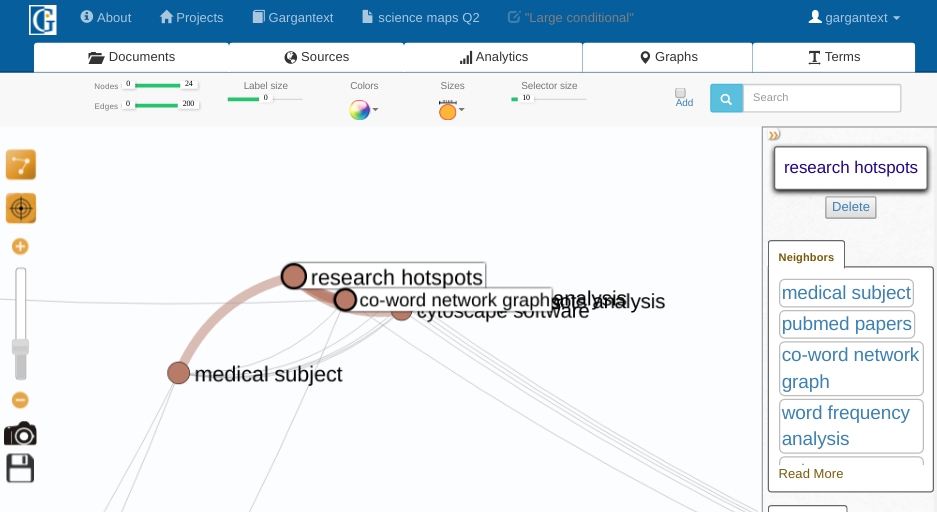
Click here to remove the selected nodes from this map and the map list of the project.




Laisser un commentaire
Rejoindre la discussion?N’hésitez pas à contribuer !