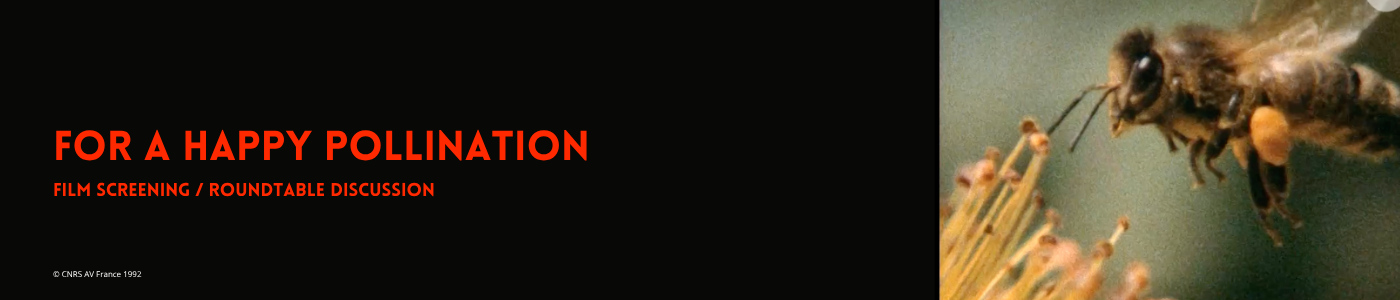
Three archival films will introduce a roundtable discussion on pollinating insects and their role in preserving biodiversity. These three historic films, remarkable for their visual beauty, offer a glimpse into the complex organisation of bee colonies and the mechanisms of pollination. The profound physiological transformations undergone by worker bees allow them to perform different roles throughout their lives, while maintaining a high degree of coordination with their fellow bees. This makes the hive one of the most fascinating examples of a self-organised complex system.
All three films will be screened from the original film prints.
The screening will be followed by a roundtable with Mathieu Lihoreau, CNRS researcher, and Colin Fontaine, CNRS ecologist, exploring the role of insects — and pollinators in particular — in the food webs that support biodiversity. The discussion will address the impact of agriculture, climate change and pollutants on pollinators’ cognitive abilities and their interactions with plants.
Excerpts from the following film will also be screened during the roundtable:
Ants, Bees: Tiny Bodies, Big Intelligence
By Julien Dechamps and Sébastien Chavigner, CNRS Images, 2023
Their brains are tiny, yet they can navigate, communicate, and even develop complex strategies to feed their communities… Social insects display remarkable intelligence, enabling them to build genuine societies despite having brains that are infinitely smaller than ours. But how do we measure the intelligence of an insect with which we have (almost) nothing in common? We head to the Centre for Animal Cognition Research in Toulouse, where scientists have developed extraordinary methods for getting inside the minds of ants and bees!