About

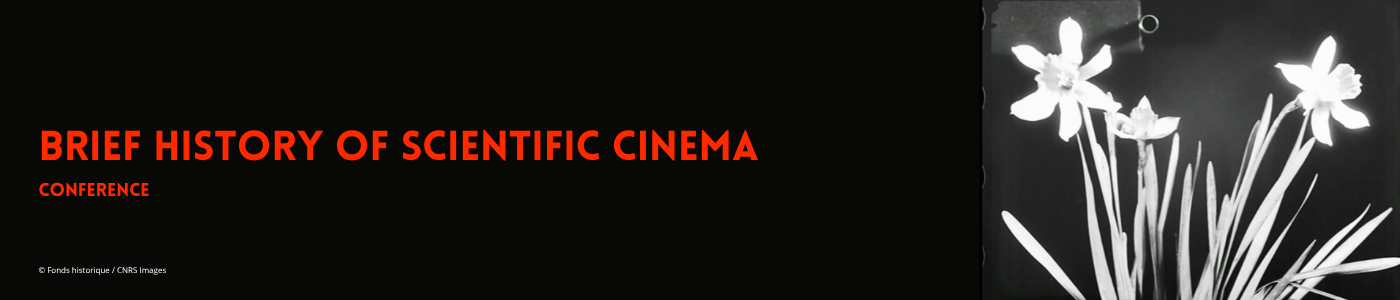
Cinema was born as a scientific endeavour before becoming a commercial medium. Jules Janssen, an astronomer, and Étienne-Jules Marey, a physiologist at the Collège de France with a keen interest in the flight of birds, were pioneers as early as 1874, long before the Lumière brothers’ first public screening in 1895.

Alexis Martinet, a former physicist at the CNRS and Vice-President of the Institut de cinématographie scientifique, will give a talk exploring the history and key issues of scientific cinema, at the intersection of research, technology and audiovisual creation.

Through examples from physics, the talk will show how moving images have made it possible to reveal phenomena invisible to the naked eye, slow down or speed up time, and transform our perception of the world around us.

This talk will also explore the historical links between experimental cinema, technological innovation and scientific research, while highlighting the legacy of major figures such as Dr Eugène Doyen, Jean Painlevé and the pioneers of scientific cinema.

Conference

Auditorium
17H30-18h

PARTICIPANTS

Alexis Martinet

Alexis Martinet, a filmmaker and specialist in scientific cinema, has spent several decades promoting the connections between science, moving images and audiovisual creation. Vice-President of the Institut de cinématographie scientifique, he works to share knowledge about the history of scientific cinema, analogue film techniques and the use of images in scientific research. Co-author of Le cinéma et la science, published by CNRS Éditions, he regularly takes part in events exploring the relationships between art, science and audiovisual heritage.