By Emilien Dubuc, 13’, 2023
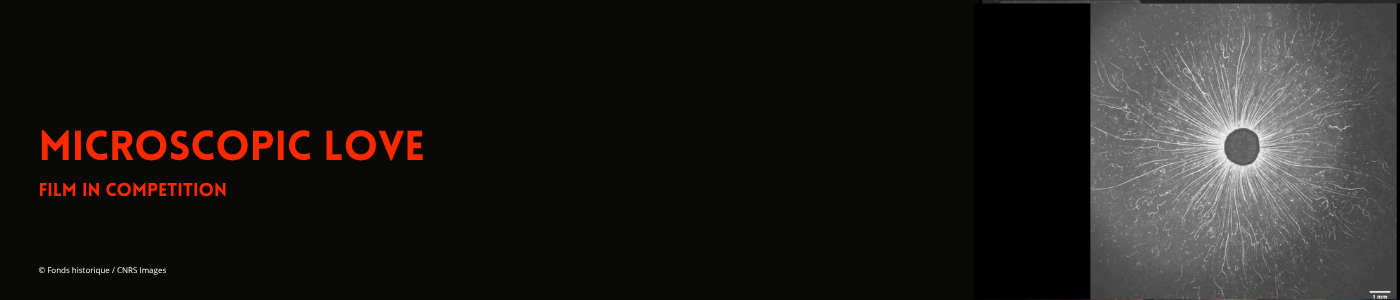
A recently emigrated young biochemist tries to understand the origins of life by reconstructing an artificial cell, while adjusting to life as a newcomer, moving between the microscope and the real world with his new friends.
Author’s note:
In my third year, one of my workshops focused on editing. Since I needed to quickly gather images and sounds in order to get to the heart of the exercise, I decided to make a found-footage film — more specifically, a love story made from archival video footage from scientific publications. A film that would require very little shooting, one that would draw on my own experience as a scientist (and would therefore be a document), but that would also leave enough room for fiction not to get bogged down in the not-always-glamorous daily life of a PhD student. I liked the idea of talking about science again, building a bridge between the twelve years I had spent working in a laboratory and my desire to express myself through film.
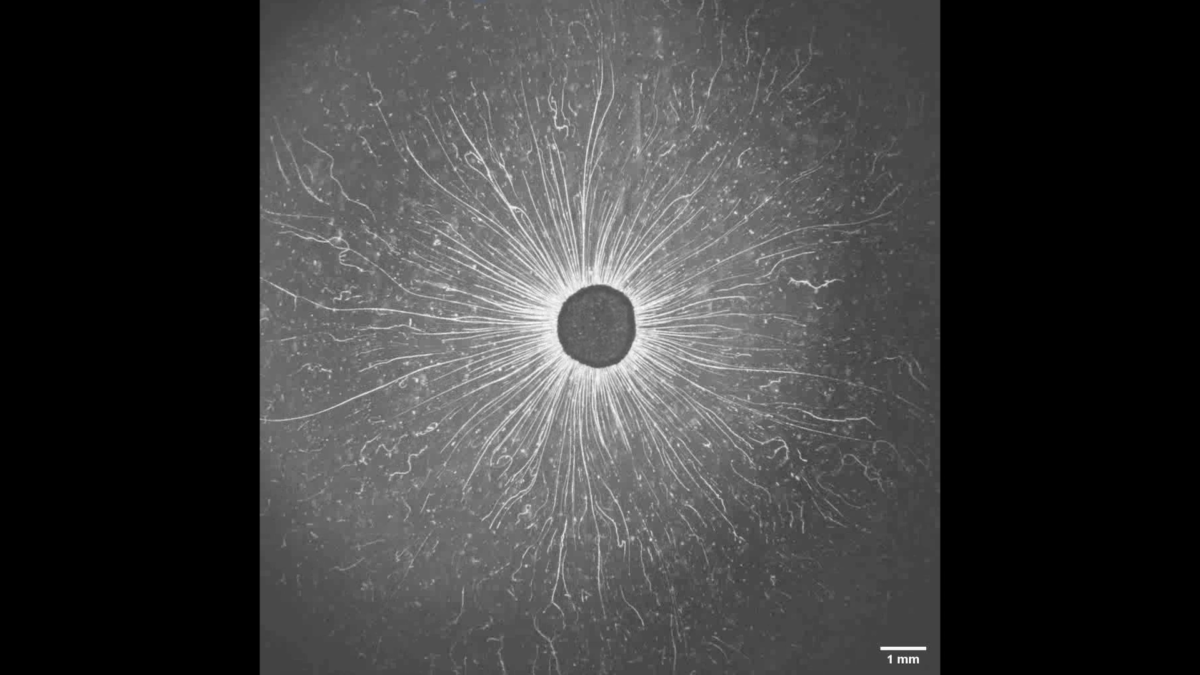
Many scientific publications, particularly in the field of synthetic biology, are based on experiments documented through microscopy. Unfortunately, scientific papers are rarely freely accessible, as academic research is subject to financial exploitation by a handful of major scientific publishing groups, including Elsevier, Nature and Springer, to name just a few. This exploitation is justified by a supposed guarantee of editorial quality, regularly called into question by the retraction of numerous fraudulent papers.
After leaving academic research, I realised just how quickly independent researchers can be left out, because the main tool for communicating scientific knowledge — academic publishing — is no longer accessible to them due to prohibitively expensive subscriptions. The exception is papers resulting from publicly funded research in Europe, for which laboratories often have to pay an extraordinarily high additional fee to make a publication “open access”.
There is, however, an interesting loophole: many papers come with supplementary materials, often video footage or relatively raw photographs of experiments. These supplements are not controlled by publishers, meaning they remain freely accessible and are often released under Creative Commons licences, which allow the images to be freely reused and manipulated — for example, to make films. So I downloaded everything that interested me (I had kept notes from my time as a researcher about which papers contained the most beautiful images), and quickly began editing. It turned out to be great fun.